Mud, Boots and a Warm Light: Designing the Garden Side of the Back Door
There is a stretch of ground in every cottage garden that nobody designs and everybody uses. It runs from about a metre out from the back door to about a metre in, and between November and March it is the hardest-working square footage on the property. Wellies land there. So do wet dogs, sacks of compost, dripping coats, the recycling, and roughly four hundredweight of leaf litter from the sycamore two doors down.
Most of us treat that strip as leftover space — something to step over on the way to the kettle. But it deserves a plan, because a threshold that works changes how the whole garden feels. Get it right and the mud stays outside, the house stays warmer, and the walk from car to sofa stops being a chore.
Begin on the garden side, not the hall side
The instinct is to start indoors: buy a bench, buy a mat, hope for the best. Resist it. Water is the enemy, and water arrives from outside. If the ground beyond the door is level, boggy or paved to a standstill, no amount of coir matting will save you. Sort the drainage first and the interior suddenly becomes easy.
Take a walk out there on a wet afternoon — genuinely wet, not a drizzle — and watch where the puddles gather. That is your information. Most small gardens have one low corner by the door where everything pools, usually because a downpipe discharges straight onto flagstones or because the paving was laid with a fall that points the wrong way. A shallow channel, a section of gravel or a length of the old stone just reset with a bit of tilt will do more than any product sold as a "mud solution".
Give the water somewhere to go
If you can lift a couple of paving slabs, fit a simple gravel-filled channel along the base of the wall. Two spadefuls deep, lined with weed membrane, filled with 10–20mm gravel, and it will swallow the splash from a roof and the run-off from boots without turning into a pond. It costs almost nothing and it is invisible once the leaves fall on it.
Where the ground is genuinely flat and there is no fall to play with, a French drain is overkill for most plots but a soakaway crate under a gravel patch is not. In a courtyard or a paved yard, a couple of large, shallow gravel trays set flush with the surface will catch the worst of it — and they double as a place to stand a wet pot.
A roof, however small
A storm porch is the single best investment at this end of the house, and it does not have to be grand. A pitched canopy of about 1.2m deep over the door, in timber with a slate or clay tile roof, keeps rain off the step, off your shoulders and off the paint. It also gives you somewhere to hang a light and a hook.
If a canopy is not possible — a listed wall, a rented flat, a budget that has already gone on compost — a wall-mounted awning or even a simple shelf-roof over the door will still break the worst of the weather. Half a metre of cover is the difference between arriving soaked and arriving merely damp.
The gravel tray, upgraded
The classic gravel tray is a plastic seed tray with gravel in it. Fine, but you can do better. A shallow wooden or galvanised trough, 8–10cm deep, filled with washed pea gravel, set directly outside the door, gives boots somewhere to shed their load before they cross the threshold. It looks intentional rather than improvised, and it survives being kicked.
Pair it with a boot jack screwed to the wall at about knee height, and a stiff-bristled brush on a length of twine. Small courtesies, but they mean people actually use them.
Planting that shrugs off being stood on
Threshold planting has a hard life: deep shade for half the day, root disturbance, road salt, and the occasional careless footstep. Choose accordingly. Ferns, epimedium, hardy geraniums, hellebores and sweet woodruff will all cope with a north-facing wall and the odd trampling. For scent, a sarcococca or a winter honeysuckle by the door is worth its space — you smell it every time you come home.
Keep anything precious out of the trample line. A pot of ivy on the wall side, rather than at ground level, gives you greenery without the risk. And nothing spiky, nothing that hooks a coat sleeve, nothing that sulks when it is dark for eighteen hours a day.
Light that flatters mud
A muddy threshold lit by a stark white security floodlight looks like a crime scene. Use a warm, low-level light instead — a small bulkhead or bollard at around 2700K, ideally on a PIR sensor so it comes on when you arrive with your arms full. If you have a porch, a pendant under the canopy is the nicest thing you can do for a dark November evening, and it makes the garden path readable without turning the whole plot into a runway.
Inside: the drip zone
Now to the bit everyone thinks of first. The mistake indoors is trying to keep the floor dry. Accept that the first metre will get wet and design for it. A bench with an open slatted base and a shelf underneath lets boots drip onto a hard surface rather than into a cupboard. Hooks at two heights — high for coats, low for leads and bags — keep the through-route clear.
Use washable textiles and stop worrying. Coir or woven polypropylene matting at the door, machine-washable cotton or jute runners, and an old Welsh blanket on the bench rather than a fitted cushion. Nothing that cannot go in at 30°C.
If all you have is a back door and a narrow path
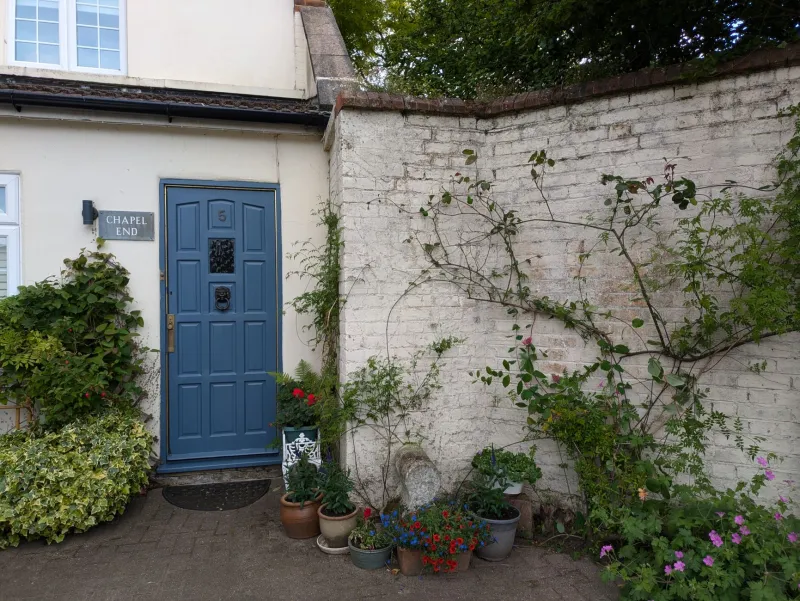
Plenty of us do. In that case, be ruthless: gravel tray outside, boot jack on the wall, coir mat inside, one tall narrow shelf, hooks above it, and a lidded box for the things that would otherwise colonise the floor. It is not a boot room. It is a system, and a system is what matters.
The two metres by the back door will never be the prettiest part of a cottage garden. But treat it as a designed space — drainage, shelter, gravel, planting, light — and you will notice the difference every single day from October to April.