Your Neighbour's Oak Is Your Best Design Feature
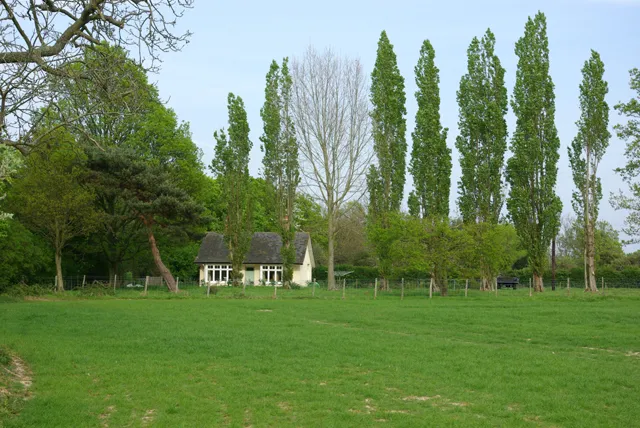
Photo: Robin Webster, CC BY-SA 2.0, via Wikimedia Commons
The best thing in my garden doesn't belong to me. It's a hawthorn hedge two doors down, a pear tree leaning over somebody's garage roof, and — on a clear evening — a church tower that appears in the slot between two semis. I didn't plant any of it. I water none of it. It does more for the view than everything I've put in the ground combined.
That's the borrowed view: the cottage-garden trick of designing around what's already over the fence. In a small plot it is the cheapest square footage you will ever gain, and it costs nothing but attention.
An old idea in new wellies
Landscape designers have leaned on this for centuries. Humphry Repton sold it to country-house owners in the 1790s as 'appropriation' — the polite fiction that a neighbour's parkland belonged to your view. In Japan the same instinct is called shakkei, borrowed scenery, and the principle hasn't shifted since: you don't own it, you frame it, and you let the eye travel.
British plots are made for it. Boundaries are close, neighbours are closer, and there is usually something worth borrowing — a mature tree, a roofline, a hedgerow, a horizon — if you stop treating the fence as the end of the garden and start treating it as a picture mount.
Sit down before you spend anything
Most of us garden from standing height, mid-stride, doing three things at once. Borrowed views don't reveal themselves that way. Sit where you actually sit: the kitchen window with the kettle on, the bench with a mug, the step where you take your boots off. Note what your eye does. Does it stop dead at six feet of panel fencing? Does it slide along the boundary and out through a gap you'd forgotten about?
The useful bits are rarely straight ahead. Look for the slot between two houses, the gap above a hedge, the triangle of sky over a shed. Those are your frames. Everything else in the design is there to make them more obvious.
The deliberate gap
Closeboard panels are efficient, private and utterly viewless. If privacy is the priority, keep them — but consider a trellis topper, a slatted screen or a hit-and-miss fence, all of which let light and glimpses through without exposing you to the neighbours' bins.
If you rent, this is where doorstep gardening gets creative. A slatted screen hooked over an existing fence, a fan trellis cable-tied to a post you've been given permission to use, a tall pot positioned so the eye goes up and over rather than straight at the panel. It's not cheating. It's staging.
Mirrors, arches and other honest cheats
A mirror on a boundary wall works because the eye believes it for a second, and a second is all you need. Hang it where it reflects greenery, never where it bounces sun into a neighbour's window — that's a genuine nuisance and a fast way to sour a fence line. In exposed spots, use a proper outdoor mirror with a sealed back; cheap glass fogs and looks like a bathroom accident by February.
Arches earn their keep here too. Most people put them over a path so they can walk beneath something. Try instead an arch set against the boundary and angled to frame whatever sits beyond it — a chimney, a birch, a distant hill. You aren't walking through that arch. You're looking through it.
Hedges that frame rather than block
A boundary hedge doesn't have to be a wall with leaves on. Keep it lower than eye level in one section — a 'window' clipped into yew, privet or beech — and you'll gain a view and a strong piece of structure at the same time. Yew takes a crisp cut better than almost anything; beech holds its leaves through winter, which keeps the frame warm when everything else is bare.
Where a neighbour's hedge is the thing you're borrowing, resist the urge to plant your own tall screening right in front of it. Repeat the same species along your side instead, at a lower height, and the two read as one continuous boundary. It's a small deception with a big payoff.
Planting that steers the eye outward
Colour does most of the directing. Cool blues, greys and greens recede, so they belong near the boundary where you want the space to keep going. Warm oranges, crimsons and golds advance, so keep them close to the house, where they create intimacy and stop the garden feeling like a car park.
Then there are the see-through plants — the ones that give height without shutting the view down. Verbena bonariensis is the famous one, but Thalictrum delavayi, bronze fennel, Deschampsia cespitosa and the taller alliums all do the same job: they put something in the eyeline without blocking what's behind. Plant them in loose crowds along the boundary rather than in tidy rows, and the garden starts to look like it carries on past the fence.
Don't forget the biggest borrowed thing of all
Sky. It's free, it's enormous, and it's the one element no boundary can take away. Vertical accents — a slim tree, a tall obelisk, a climbing rose on a hoop — pull the eye up and out of the plot, which is precisely where a small garden needs it to go. A low-slung garden under an open sky feels expansive. A garden full of mid-height clutter feels like a corridor.
Awkward plots and overlooked gardens
If you're hemmed in on all sides, borrow upward rather than outward and be scrupulous about the neighbours' side of the bargain. Keep hedges cut back from the boundary line, don't block established light, and remember that a high hedge dispute can escalate quickly under the antisocial behaviour legislation that's been on the statute book since 2014. Good borrowing is a two-way courtesy: you get their oak, they get a boundary that doesn't need arguing about.
For genuinely overlooked gardens — new-build courtyards, north-facing terraces, that peculiar back strip behind a shop — the sequence is the same. Find the sightline that's worth keeping. Frame it. Plant low and loose around it. Let the eye leave the garden through the one gap you've chosen, and it will forgive you the six-foot panel on the other three sides.
A short prompt list
- Sit in three places you actually use and write down what each one looks at.
- Identify one view worth keeping and one spot where the eye dies. Protect the first, break the second.
- Lower one section of boundary planting to shoulder height and see what appears.
- Add a mirror or an arch purely as a frame, not as a feature.
- Cluster three see-through tall plants where your sightline exits.
- Push cool colours to the edges and warm colours towards the door.
None of it is a substitute for owning an oak. It's better than that, in a way — a garden that admits it's part of a larger view is more honest, and far more romantic, than one that pretends to be an island.