Climbing the Boundaries: Turning Fences, Walls and Sheds into Cottage Garden Space
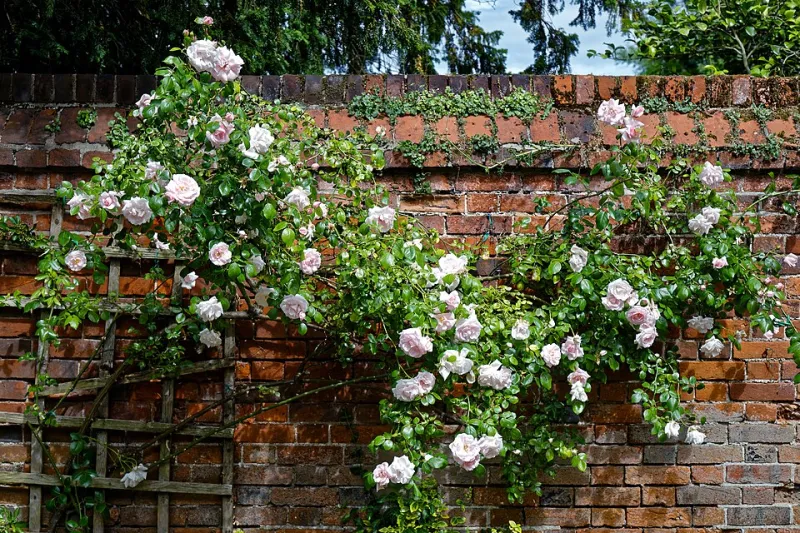
Photo: Acabashi, CC BY-SA 4.0, via Wikimedia Commons
In a small British garden, the ground gets all the attention. We fuss over borders, squeeze in pots and argue about lawn. Meanwhile, the boundaries do nothing. A fence, a brick wall, the side of a shed: these are vertical acres with the footprint of a doorstep. Cottage gardening has always understood this. The romantic look we are chasing is not just a border full of roses and lupins; it is a rose over a door, honeysuckle on a shed and sweet peas scrambling up an obelisk. The wall is the garden.
As November 2026 settles in, this is the right moment to plan. Bare-root roses and wall shrubs can go in while dormant, supports are easier to fix before growth, and you can still see the bones of the plot.
Start with the support, not the plant
Climbers are only as good as what holds them up. A rose that is expected to cling to a pebbledash wall will sulk; a clematis tied to a loose wire will flop. Decide on the support before you buy the plant.
On brick or stone, vine eyes and tension wire are the classic answer. Fix them into the brick rather than the mortar where possible, and leave a little space between the wall and the wire so air can move. On a wooden fence, a trellis mounted on battens is kinder than one screwed flat against the panels. The gap stops damp collecting behind it. On a shed, the same rule applies: battens first, trellis second, and a gap for airflow.
If you rent, do not reach for the drill. Freestanding planters with built-in trellis, obelisks in pots and tension wire between existing posts can all clothe a boundary without touching the landlord's wall. Cable ties around fence posts are usually harmless; cable ties through the panels are not. Check whose fence it is before you add weight, and keep heavy pots on the ground rather than hanging from a shed.
North and east: the quiet boundaries
A north-facing wall is not a dead zone. It is a cool, steady place, and several cottage favourites are perfectly at home there. Climbing hydrangea will self-cling once established, though it takes a year or two to get going. Ivy is the reliable evergreen, and winter jasmine gives a scramble of yellow in February when little else bothers. Garrya elliptica brings those long, grey-green catkins, and pyracantha earns its place with berries and thorny privacy.
On an east-facing boundary, you get morning sun and afternoon shade. That suits early clematis such as Clematis alpina, honeysuckle and flowering quince. It is also a reasonable spot for some climbing roses, especially the paler, tougher sorts that dislike being scorched. What it will not suit is wisteria or a sun-loving annual scrambler. Match the plant to the light and you spend far less time coaxing.
South and west: the performers
Give a climber sun and it usually gives you scent. Climbing roses such as Rosa 'New Dawn' or 'Madame Alfred Carrière' will cover a wall, though the latter tolerates a little shade too. Clematis viticella types are useful because they flower on the current season's growth and can be cut back hard in late winter. Jasmine, honeysuckle and sweet peas bring the evening scent. For a quick annual cover, cup-and-saucer vine, Spanish flag and nasturtium will romp away in a warm summer.
This is also where you get privacy. A south-facing fence clothed in a rose and a viticella clematis gives you flowers and a screen without eating into the lawn. The trick is to keep the lowest metre clear enough that the garden still feels open at ground level.
Pruning without fear
The main thing is to know which clematis you have. Group 1, which includes montana and alpina, is pruned straight after flowering. Group 2 is tidied in late winter or early spring, before the first flush. Group 3, the viticellas and late-flowering types, is cut back hard in late winter. Roses are pruned in late winter while dormant. Honeysuckle is trimmed after flowering. Pyracantha is best pruned after its berries have done their thing, not in the middle of nesting season. Keep ties loose enough to allow the stem to swell.
A small plan by aspect
- North wall: climbing hydrangea for structure, winter jasmine for early colour, ivy for evergreen cover.
- East fence: flowering quince and Clematis alpina, with sweet peas in a pot at the sunnier end.
- South wall: a climbing rose and a viticella clematis, plus an obelisk of sweet peas.
- West shed: honeysuckle and jasmine, with nasturtium scrambling through in summer.
None of this takes up ground space. That is the quiet advantage of vertical gardening: you get the cottage garden layers, the scent by the door and the screen from the neighbours, while the border below stays free for pots, herbs or a bench. Plant bare-root now, fix the wires while you can still feel your fingers, and let the boundaries earn their keep in 2026.