The View From the Landing: Designing a Small Garden for the Upstairs Eye
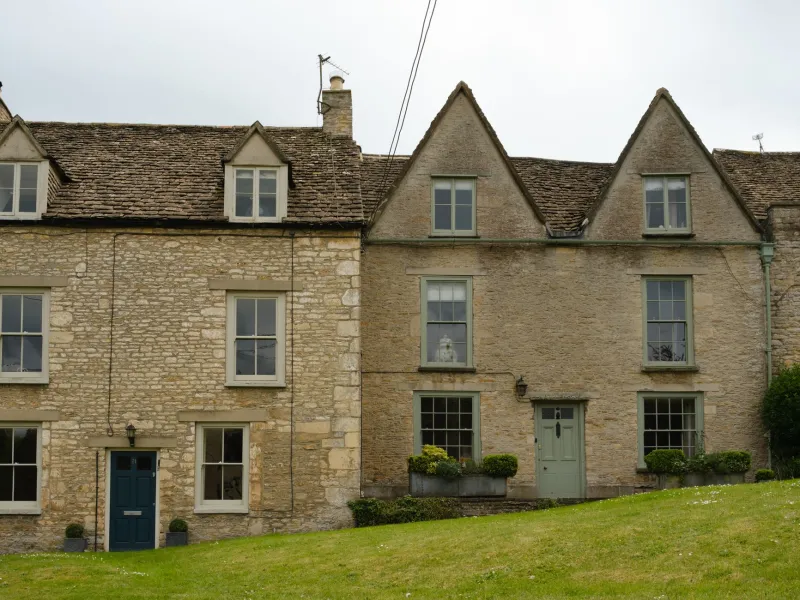
Most garden writing assumes a reader standing in the middle of a lawn, hands in pockets, thinking about a border. In a small British house that reader hardly exists. The strip outside the kitchen door is two strides wide, and the view you actually live with — the one you see while folding washing, cleaning your teeth, or pausing halfway up the stairs — is from about four metres up, through a sash window with a slightly cloudy lower pane.
That view has its own rules, and practically nobody designs for it. Here is the case for doing so.
Your best view is the one you never planned
Walk through any Victorian terrace or 1930s semi and the geometry repeats itself: a postage-stamp back garden, a first-floor back bedroom, and a window that frames the whole plot like a picture in a frame slightly too small for it. From up there you see what the ground-level gardener cannot. The shape of the plot as a single object. The dead gap behind the shed. The honest colour of the soil in February. The corner where the bins live, which you have spent seven years not noticing.
You also see the garden's silhouette against next door's roof — and that, it turns out, matters more than any planting plan you will ever draw.
Design for the plan, not the elevation
At eye level a border is a wall of leaves. From above it is a shape: a crescent, a wedge, a long ribbon. That distinction should change what you spend money on. Ground surfaces — gravel, bark, mown grass, paving — read as blocks of colour from a window, so a pale gravel path against dark soil is doing structural work all year, while a bed of perennials is doing nothing at all between November and April.
So buy the drawing before you buy the plants. Define the outline with clipped evergreen — box, yew, a low rosemary hedge, a run of lavender — and let those lines do the job from above while the perennials get on with the job at ground level.
Curves read as ribbons
A gently curving path is one of the great cottage-garden moves, and from an upstairs window it is genuinely beautiful: a pale ribbon lying across dark earth. At ground level, though, a tight curve often just looks like a mistake with a kerb. Make curves generous and shallow — one long S rather than a squiggle — and check it from the window before you cut anything. A garden hose laid out on the ground and photographed from the back bedroom will save you a weekend of lifting paving.
Cluster, don't scatter
Pots are where small gardens live or die, and the upstairs eye is unforgiving. Three pots spaced evenly around a patio read as three sad dots. The same three pots pulled into a triangle, tallest at the back, read as a single mass of colour and foliage — which is what you want.
Group in odd numbers, vary the heights with a bench, a raised planter or an upturned crate, and repeat one material so the cluster looks deliberate. A row of pots along the top of a low wall is another useful trick: from above it becomes a band of colour at chest height, which is exactly what a bare January plot lacks.
Borrow the skyline
Looking down also means looking across, and every small garden has borrowed scenery it ignores. A chimney stack. A church tower. A neighbour's oak, a line of allotment sheds, the curve of a terrace roofline. Find the best of these from your landing window and compose around it: put an upright shrub or a small tree just beside the borrowed object rather than in front of it, so the two read together.
And resist the urge to plant the tallest thing in the middle of the plot. From above, a central tree closes the view like a hand over a lens.
What winter gives away
From November to March the upstairs view is mostly ground, and ground is where small gardens look poorest. Mulch, gravel, moss, a stone bench, a pot of wintergreen — anything that gives the soil some company — earns its keep. Evergreens matter twice as much: a pair of matching standard bays flanking the path, two pots of olive either side of the step, sarcococca in the shade by the fence. Repetition is what makes a view from a window look composed rather than accumulated.
While you are up there, look at the top edge of the fence and the scruffy strip behind it. Nobody sees that from the patio. Everybody sees it from the bathroom.
The clutter only visible from above
The wheelie bin. The hose reel. The stack of empty pots you are definitely going to use. The trampoline. From ground level these are furniture; from the landing they are the composition. Screen the bins with a hurdle or a clipped shrub, coil the hose on a bracket, and give the empty pots a home behind the shed. It is a twenty-minute job that improves the garden more than a new rose would.
A wet Sunday experiment
Take a photograph from every upstairs window that overlooks the garden. Print them, tape them to the kitchen wall, and sketch over the top: where are the lines, where are the gaps, what is the garden's outline? Then choose three shapes you would be happy to look at for a decade.
Cottage gardening is usually described as something you do with your hands. Half of it, in a small British garden, is really something you do with your eyes — and the most important pair of eyes in the house are the ones at the top of the stairs.